
Humanoid Robots
Accelerate the development of advanced AI robotics.
Workloads
Robotics
Industries
Healthcare and Life Sciences
Manufacturing
Retail / Consumer Packaged Goods
Business Goal
Innovation
Return on Investment
Products
Overview
The Next Era of Physical AI
General-purpose humanoid robots are built to quickly adapt to existing human-centric urban and industrial work spaces, helping tackle tedious, repetitive, or physically demanding tasks.
These robots are finding their way from factory floors to healthcare facilities, where they’re assisting humans and alleviating labor shortages with automation.
However, building humanoid robots presents layers of complexities and engineering challenges. These include replicating human-like perception, degrees of freedom, dexterity, mobility, cognition, and whole-body control.
This demands accelerated progress in robotics research fields and technologies, including artificial intelligence, machine learning, physics-based simulation, sensor technologies, embedded computing, and mechatronics.

Figure
Quick Links
Technical Implementation
Advancing Humanoid Robot Development
NVIDIA is developing accelerated systems, blueprints, tools, services, algorithms, and other robot technologies that can be used to build general-purpose, human-form-factor robots.
Three-Computer Solution
Humanoid robots need to sense, plan, and act autonomously within a given environment, which involves processing large amounts of data in real time. This requires training foundation models that power the robot brain, simulating and validating the robot brain, and finally deploying these brains and associated software onto the actual robot.
The three AI systems are:
- An NVIDIA AI supercomputer—an NVIDIA DGX™ with NVIDIA H100 or B100 processors—for training powerful, generative physical AI models and robotic foundation models.
- An NVIDIA OVX™ computer with NVIDIA RTX™ GPUs for synthetic data generation, robot learning, and testing in simulation, with simulation frameworks such as NVIDIA Isaac Sim™ and Isaac™ Lab built on top of NVIDIA Omniverse™.
- An on-robot runtime computer, such as NVIDIA Jetson Thor™—built on NVIDIA’s Blackwell architecture—that can run low-latency, high-throughput inference.

NVIDIA Isaac GR00T
NVIDIA Isaac GR00T is an open reference platform for general-purpose humanoid robots that enables developers to build, train, test and deploy AI-powered robots.
Robot Foundation Models
Humanoid robots need diverse skills for varied tasks, traditionally requiring separate, costly AI models. Robot foundation models solve this by training on broad data, developing generalizable skills. This allows robots to adapt to different tasks and environments.
Isaac GR00T open foundation models are ideal for generalized humanoid robot reasoning and skills. This cross-embodiment solution takes multimodal input—including language and images—to perform manipulation tasks in diverse environments.
These models are trained on an expansive humanoid dataset consisting of real captured data, synthetic data, and internet-scale video data. They’re also adaptable through post-training for specific embodiments, tasks, and environments.
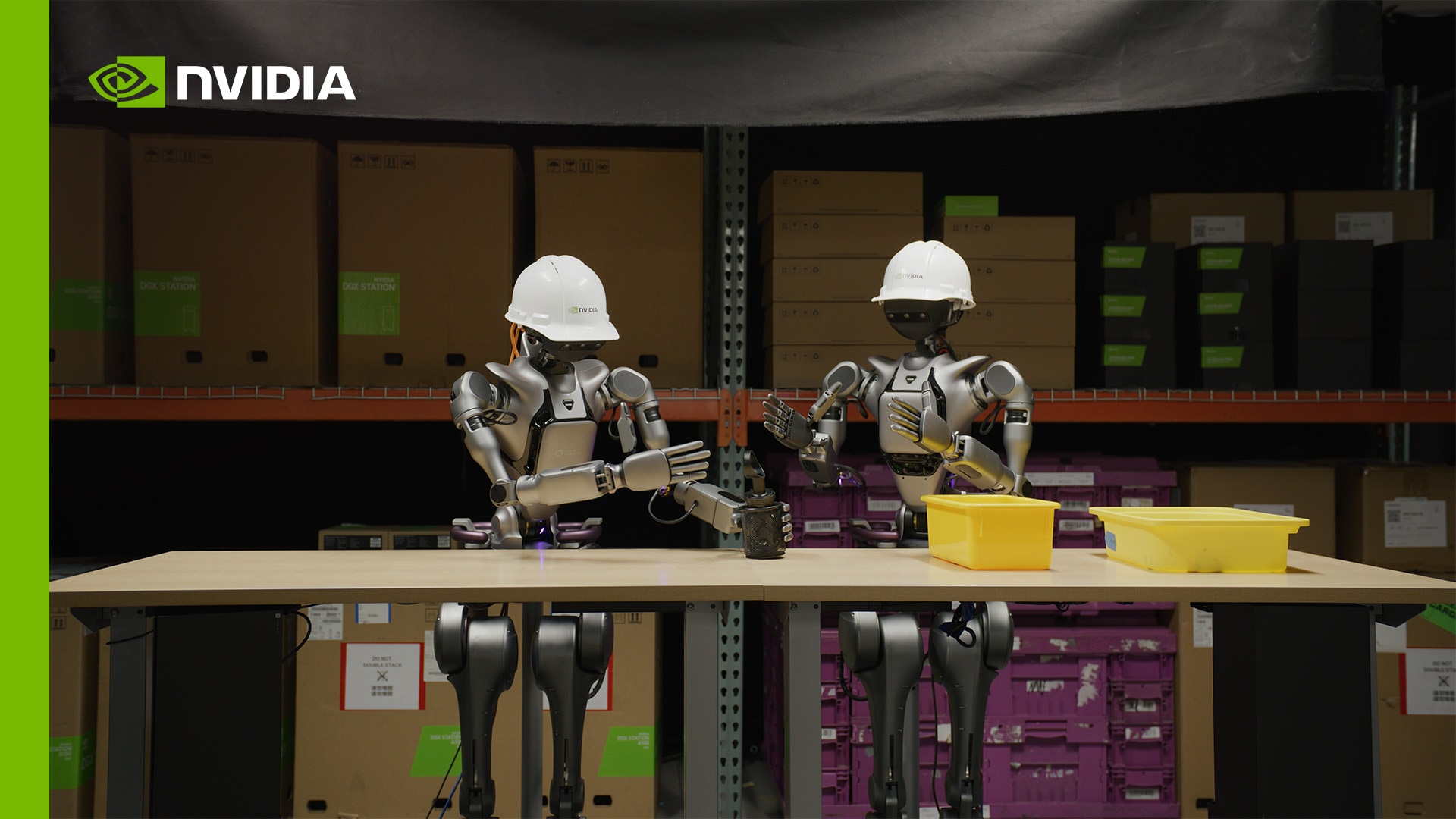
Isaac GR00T models can easily generalize across common tasks—such as grasping, moving objects with one or both arms, and transferring items from one arm to another—or perform multi-step tasks that require long context and combinations of general skills. These capabilities can be applied across a variety of use-cases, including material handling, packaging, and inspection.
Robot Learning and Simulation Frameworks
Simulation is key for developers to train humanoid robots across a variety of physically accurate environments and conditions, before deploying them in the real world.
Robot learning and simulation frameworks like NVIDIA Isaac Sim and Isaac Lab—built on the Omniverse platform—enable physically accurate simulations for training and validating multiple humanoid robot agents in parallel.
Isaac Lab is an open-source unified robot learning framework built on Isaac Sim that can be used to apply these learning techniques to train a robot policy. The trained robot policies can then be validated in Isaac Sim, a reference application for building, simulating, and testing humanoids in physically based virtual environments.
The Next-Generation, On-Robot Computing Platform
Robot hardware is also crucial for running an ensemble of multimodal AI models that power humanoids with the right performance, latency, and functional safety in diverse conditions.
NVIDIA Jetson AGX Thor, based on NVIDIA’s Blackwell GPU architecture, delivers ultra-high-performance AI compute and a new transformer engine. This delivers the necessary AI superpower at the edge to enable the new generation of humanoids.
Quick Links
Ecosystem
Get started with our humanoid robotics partners.


Get Started
Develop Humanoid Robots
Advance your humanoid robot development with Isaac GR00T foundational technologies by accessing tutorials, forums, release notes, and comprehensive documentation.
FAQs
Humanoid robots are designed to work in human-centric spaces, taking on tedious, repetitive, or physically demanding tasks in factories, warehouses, hospitals, and retail environments. Near term, this includes material handling, picking and placing items, machine tending, basic inspection, and assisting workers with lifting, carrying, or transporting goods.
NVIDIA Isaac technologies provide an end-to-end stack for training, simulating, and deploying humanoid robot “brains.” This includes access to Isaac GR00T open models for generalized reasoning. Developers can also leverage Isaac Lab, an open-source robot learning framework, to iterate quickly, reuse skills across embodiments, and validate policies in Isaac Sim before deploying to hardware.
Simulation lets teams train and test humanoids in digital twins of real facilities before any physical deployment, so they can evaluate behaviors, edge cases, and failure modes without risking people, equipment, or robots. This sim-first approach reduces the need for expensive physical prototypes and large-scale on-site testing, helping catch integration issues earlier and shorten deployment cycles.
NVIDIA’s platform is built to address the robotics data gap by combining limited real-world demonstrations with large-scale synthetic data and simulation. Using the open-source Isaac Lab framework and Isaac Sim, developers can generate vast amounts of photorealistic training data. Additionally, blueprints like GR00T-Dreams use Cosmos world foundation models to create entirely new synthetic trajectory data from simple instructions, helping bootstrap policies without requiring massive real-world datasets upfront.
Humanoid robots require powerful onboard compute to process multimodal data and ensure functional safety without relying on cloud connectivity. NVIDIA Jetson AGX Thor, built on the Blackwell architecture, serves this role by delivering the AI performance and low latency needed to run generative AI and foundation models directly on the robot. This allows the robot to sense, plan, and act autonomously in diverse, real-world environments.
Quick Links
RTX PRO Server—the Best Platform for Industrial and Physical AI
NVIDIA RTX PRO Server accelerates every industrial digitalization, robot simulation, and synthetic data generation workload.


